 Katsushi OHATA
Katsushi OHATA
FINDING OF INQUEST
An Inquest taken on behalf of our Sovereign Lady the Queen at Adelaide in the State of South Australia, on the 21st day of March 2021 and the 9 th day of February 2022, by the Coroner’s Court of the said State, constituted of Anthony Ernest Schapel, Deputy State Coroner, into the death of Katsushi Ohata. The said Court finds that Katsushi Ohata aged 51 years, late of no fixed abode died at the Nullarbor Cliffs, Nullarbor, South Australia between the 11th day of March 2015 and the 21st day of March 2015 as a result of an undetermined cause. The said Court finds that the circumstances of his death were as follows:
1. Introduction and reason for inquest
1.1. These are the findings of an inquest into the fate of a person believed to be Katsushi Ohata, a male Japanese national whose date of birth was 20 March 1963.
1.2. On Saturday 21 March 2015 a collection of personal property, some of which bore the name Katsushi Ohata, was found at a cliff top overlooking the Southern Ocean, approximately 50 kilometres west of Nullarbor in South Australia. The location was accessible by way of a single lane ungraded dirt track approximately two kilometres south of the Eyre Highway. This location is in South Australia in a region known as the Nullarbor Plain.
1.3. Police were alerted to the collection of personal property by a camper. The camper had located and taken possession of a bag containing cash in the form of banknotes. This was one of several items of personal property that were strewn around and just below the cliff top. The sum of money amounted to A$4,420 in various denominations.
1.4. When the cliff top scene was examined by police there was reason to believe that the apparent owner of the property, one Katsushi Ohata, had ridden a bicycle over the cliff and into the sea. I have seen differing estimates in the evidence as to the height of the cliff above the sea, but suffice it to say it was significant and that a fall from the cliff would be fatal either by way of injuries sustained in the fall or by drowning.
1.5. What led police to believe that a person, probably the owner of the property, had gone over the cliff was the fact that there was evidence at the scene that the individual had been in possession of a push bike and that there were marks in the soil consistent with having been made by a bike which led towards the cliff edge and then disappeared as if a bike had been ridden over the cliff. Evidence later gathered would confirm that the person Ohata had in fact been in possession of a push bike. Nevertheless, a thorough search of the cliff top and cliff face and a search by air of the location at the foot of the cliff revealed no trace of any individual nor of a bike. To my mind the geography of this location was such that if a person and a bike had, unseen, gone over the cliff at that point, the likelihood would be that no trace of either would ever be found.
1.6. The death or possible death of the individual concerned, or of that person’s disappearance, was reported to the State Coroner. Pursuant to section 21 of the Coroners Act 2003 the Coroners Court has jurisdiction to ascertain the cause or circumstances of a reportable death or of the disappearance from, or within, the State of South Australia of any person. Hence this inquest.
1.7. The Court has found that the owner of the property located at the top of the cliff was indeed one Katsushi Ohata, a male Japanese national whose date of birth was 20 March 1963. The Court has also found that Mr Ohata is deceased and that he met his death when he rode a push bike over the cliff. It has not been possible to determine a precise cause of death for Mr Ohata. This is due to the fact that he may have died either by way of injury sustained in the fall or by drowning. The anatomical cause of death therefore is undetermined. I have found that Mr Ohata was last known to be alive on 11 March 2015 when he was seen in Ceduna on the west coast of the State, some 350 kilometres east of the cliff top. His disappearance was detected on 21 March 2015. Accordingly, I find that Mr Ohata died between 11 March 2015 and 21 March 2015. I give my reasons for those findings below. 3
2. The investigation
2.1. The possible death or disappearance of the person believed to be Katsushi Ohata was investigated by South Australia Police (SAPOL).
2.2. Very little is known about the social circumstances of Katsushi Ohata. This includes his physical and mental health history. This is due in part to the fact that the family of Katsushi Ohata in Japan did not wish to participate in the SAPOL investigation, despite the efforts of various Australian authorities and agencies. What little successful communication there was with Mr Ohata’s family did not give rise to any indication that he had returned to Japan.
2.3. What has been established in the SAPOL investigation is that a Katsushi Ohata, with Japanese passport number TH5048056, arrived at Melbourne airport via Hong Kong on 28 February 2015. These details are taken from the incoming passenger card that the individual completed when going through Australian customs and immigration. The person completing the card indicated that the intended length of stay in Australia was 14 days. However, it appears that the person was granted permission to stay in Australia for three months. Therefore, as at 21 March 2015 when property in the name of Ohata was located near Nullarbor, Katsushi Ohata had not overstayed his visa.
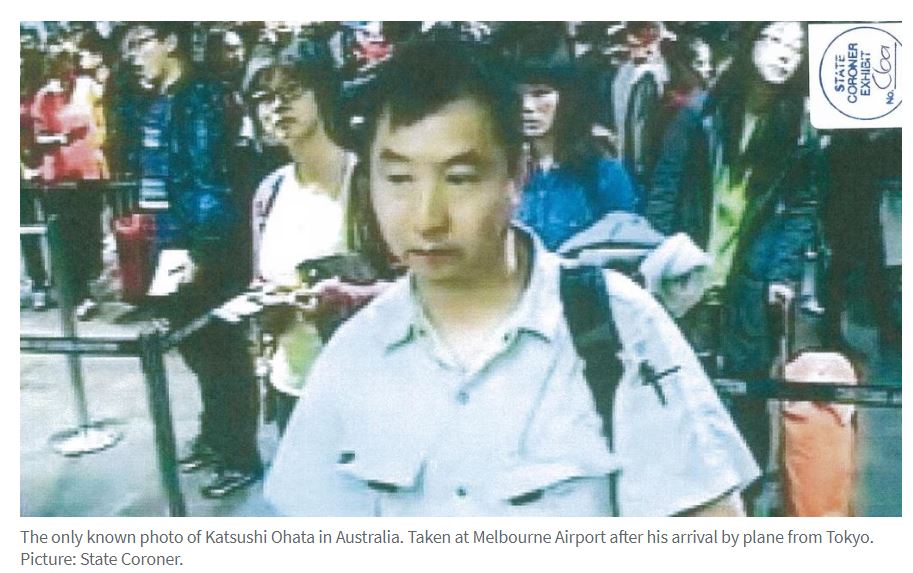
2.4. Tendered in evidence was a photograph taken of Katsushi Ohata when he presented at the immigration counter upon his arrival in Australia. One of the items found at the cliff top was a Japanese passport in the name of Katsushi Ohata. I understand that this passport has since been returned to Japan. Unfortunately, there does not appear to be an available photocopy or photograph of the details page of that passport which would no doubt have included a photograph of Ohata and from which a comparison with the immigration counter photograph might have been attempted. However, in evidence there is a photocopy of some of the other pages of the passport. 1 One of those pages bears what looks like an entry visa for Cambodia. The details on that visa are legible. The visa was issued to a Katsushi Ohata with passport number TH5048056 which is the same passport number as that written on the incoming passenger card to which I have already referred. The inference that I draw is that the passport that was located at the cliff top was used to facilitate Katsushi Ohata’s arrival in Australia on 28 February 1 Exhibit C6a, photo 27 4 2015. I further find that the person Katsushi Ohata who entered Australia on that day and the Katsushi Ohata to whom the passport located at Nullarbor relates, are one and the same person, namely Katsushi Ohata a male Japanese national whose date of birth was 20 March 1963.
2.5. Among other items located at the cliff top were three bank cards all in the name of Katsushi Ohata. All of these cards had been cut up into several pieces. A pair of scissors was located at the scene. One of these cards was a Visa card in the name of Katsushi Ohata number 4541 5129 3033 1014 with an expiry date of 12/18. It has been demonstrated that on 6 March 2015 this Visa credit card account was used to secure a deposit for an internet booking for a cabin at a caravan park in Ceduna. The card holder, a Mr Ohata, checked into that caravan park two days later on 8 March 2015. Associated documentation involved in the transaction indicates that Mr Ohata paid in advance for three nights’ accommodation on 8 March 2015. The documentation relating to this appears to bear the number of a different bank card that I do not believe has been located.
2.6. Ms Marie Bowden was the relieving manager of the caravan park at Ceduna. Ms Bowden gave a statement to police on 22 March 2015.2 The statement indicates that on the afternoon of Sunday 8 March 2015 she checked a male person of Asian appearance into a cabin for three nights. Her statement sets out the details of how the booking was made, including reference to the Visa account that was used to book the cabin and in respect of which the credit card attached to that account was located at the cliff top. Ms Bowden checked this person out of the caravan park accommodation on the morning of Wednesday 11 March 2015. Ms Bowden did not have a photograph of the male person. In her statement Ms Bowden makes reference to three matters of significance. Firstly, the gentleman in question was in possession of a push bike. Secondly, during his stay at the caravan park the individual habitually wore a long sleeve khaki shirt. Such a shirt was located by police at the cliff top. Thirdly, documentation attached to Ms Bowden’s statement makes it plain that the individual in question went by the name of Katsushi Ohata. 2 Exhibit C1 5
2.7. Mr Scott Palmer is the owner of the Ceduna Sports and Outdoor Centre. Mr Palmer provided a statement to the inquest.3 In that statement he describes a ‘male customer of Japanese appearance’ coming into his store to buy a bike on Tuesday 10 March 2015 which was the day before Katsushi Ohata checked out of the caravan park at Ceduna. Mr Palmer established through the male customer’s imperfect English that he was from Japan and that he had arrived in Australia for the purpose of riding a bike across the Nullarbor Plain. He said that he had arrived in Ceduna by bus. Mr Palmer sold him a mountain bike together with some accessories that included a helmet, a luggage rack for the back of the bike and a spare tube. Mr Palmer has been shown photographs of a helmet and spare tube that were located at the cliff top by police. He states that they are the same as those he sold to this male person. He describes the male person as a polite man who was good to deal with and who was calm and not agitated in any way. The man did not mention his name. Mr Palmer produces with his statement the tax invoice in respect of this transaction which was paid for by the gentleman by way of ‘Eftpos’. The total purchase price was $840.94. There are no details on the tax invoice identifying the Eftpos account which was used to pay for the items.
2.8. The cliff top where the property was located is 350 kilometres west of Ceduna. There is no evidence that Mr Ohata stayed in Ceduna beyond 11 March 2015 which was the day he checked out of the caravan park. If Mr Ohata had intended to ride across the Nullarbor Plain as he had indicated to Mr Palmer, he would have travelled from Ceduna in a westerly direction, logically along the Eyre Highway. The cliff top was indeed west of Ceduna and involved only a relatively small deviation from the main highway. It has not been possible to ascertain with precision how long it would have taken a person to travel by bike from Ceduna to the cliff top, but it is reasonable to conclude that the journey could comfortably have been undertaken between 11 March 2015 and 21 March 2015. It is not known where Mr Ohata would have slept along that journey. To my mind it is highly unlikely that the Asian man who bought the bike from Mr Palmer was anyone other than Katsushi Ohata. I find that this man was Katsushi Ohata and was the same man who had stayed at the Ceduna caravan park from 8 March 2015 to 11 March 2015. I further find that this was the same Katsushi Ohata who had 3 Exhibit C2 6 arrived in Australia on 28 February 2015 and was the same man to whom the property found at the cliff face belonged.
2.9. There is no immigration record of Katsushi Ohata having left Australia. 2.10. There is no evidence as to whether Mr Ohata’s Japanese bank accounts were ever used again. There is no evidence that Mr Ohata operated any bank accounts in Australia at any time. Mr Ohata has not been registered with Centrelink or with the Registrar of Births, Deaths and Marriages. Enquiries with interstate police forces reveals no record of Mr Ohata in those jurisdictions.4
3. Further detail regarding the scene at the cliff top
3.1. Supporting the notion that Mr Ohata disappeared from the cliff top is the fact, as I have already stated, that there were marks in the soil consistent with having been made by a push bike and which led to the edge of the cliff. At that point the edge of the cliff did not involve a sheer drop but proceeded to drop at an angle for some metres before it gave way to a sheer drop. Some of the items of property were located in that area of the cliff face which did not involve the sheer drop. The bike was never located, but there is no doubt that the property located in the vicinity of the cliff top had belonged to Mr Ohata.
4. Conclusions
4.1. I find that Katsushi Ohata, a Japanese national with a date of birth of 20 March 1963, arrived on his push bike at the cliff top between 11 March and 21 March 2015. I find that he was the man who had entered Australia under that name on 28 February 2015. I find that he is the same person who stayed at the Ceduna caravan park and who also purchased the push bike at the Ceduna bike shop.
4.2. I find that Katsushi Ohata met his death when he rode his bike over the cliff at the location where his property was found. The precise circumstances in which that occurred cannot be known. Equally, the time and day on which this occurred also cannot be known. 4 Exhibit C7, statement of SAPOL officer Robyn Ferraro 7
4.3. I have given careful consideration to the question as to whether Mr Ohata deliberately rode over the cliff. If he did so there would be an almost inevitable conclusion that he did so with the intent to end his own life. The manner in which Mr Ohata’s property was distributed at the scene suggests that he had abandoned it and had no further use for it. There is of course the abandoned money. As well, the fact that the credit and debit cards were cut up and rendered unusable is highly consistent with a realisation and intent that they will not be used by him or anyone else again. This, despite the fact that if Mr Ohata was to continue his journey he would most probably need those cards. The condition of the cards suggests strongly that as far as Mr Ohata was concerned his journey had come to an end. It is difficult to conceive of any person other than Katsushi Ohata having had a reason to destroy those cards. As to the $4,000 or so that was left at the scene, it may well be that Mr Ohata took a different view about the fate of that money, being understandably more concerned about credit or debit cards being used indiscriminately by others after his death.
4.4. I have considered other possibilities as to the fate of Mr Ohata. In my opinion all possibilities other than that Mr Ohata met his death by riding his bike over the cliff would have to be regarded as fanciful. For instance, if he had been deliberately pushed over the cliff face on his bike by another person, or had been made to disappear in some other sinister way, it is incongruous with such a scenario that the perpetrator did not steal the $4,000 cash. Secondly, if Mr Ohata unexpectedly met his death at the hands of some other person, this would not explain why the credit cards were cut up and effectively destroyed.
4.5. I have also considered whether or not for whatever reason Mr Ohata faked his own death or disappearance and, perhaps, left the $4,000 at the scene to throw the authorities off the scent. I would reject that as a fanciful possibility as well. If he did so, say, in order to remain in Australia undetected as an illegal immigrant, you would think that he would not have left behind such a significant sum of money, even if it was not the only money in cash that he possessed. As well, he still had two months left on his Australian entry visa. He had not come to a critical point as far as his ability to remain lawfully in Australia was concerned.
4.6. I have also considered the possibility that Mr Ohata experienced a mental health episode or became lost for some other reason and may have perished in the wilderness. But the 8 fact that he had the presence of mind to destroy his bank cards would negate such a scenario.
4.7. In summary, it is the Court’s finding that Katsushi Ohata is deceased and that he met his death by riding over the cliff on the Nullarbor Plain sometime between 11 March 2015 and 21 March 2015. I find on the balance of probabilities that Mr Ohata deliberately rode his bike over the cliff and did so with an intent to end his life. I do not know what motivated him to do so.
4.8. I would add that these conclusions are consistent with the views reached by investigating police. I here set out the overall conclusions of the investigating detective, Detective Brevet Sergeant Price then of the Ceduna CIB. I quote from his comprehensive statement.5 'I have completed all reasonable follow up enquiries regarding this investigation; I have overseen extensive searches and made an assessment of the ocean conditions at the base of the cliffs and it is my conclusion that Mr OHATA took his own life by riding his bike off the cliff face, approximately 50 kilometres west of the Nullarbor Roadhouse on the Eyre Highway, South Australia. There was minimal possibility of survival given the 300 metre drop to the ocean. There would have been no opportunity to get back to land and as a result would most certainly have drowned had he survived the drop.' I agree with that conclusion.
4.9. It is not possible to assign a precise anatomical cause of death in respect of Mr Ohata. His cause of death is undetermined.
In witness whereof the said Coroner has hereunto set and subscribed his hand and Seal the 9 th day of February, 2022.
A Japanese tourist who disappeared while on a cycling trip in South Australia's far west in 2015 did not meet with foul play, a Coroners Court inquest has found.
Katsushi Ohata, 51, was holidaying in Australia when he travelled to the town of Ceduna and purchased a mountain bike.
He told the store owner he was planning to ride the bike across the Nullarbor and checked out of a Ceduna caravan park on March 11, 2015.
The findings from Deputy State Coroner Anthony Schapel said 10 days later, a camper found Mr Ohata's belongings "at a clifftop overlooking the Southern Ocean, approximately 50 kilometres west of Nullarbor."
Among the belongings was several thousand dollars in cash, and three bank cards which had all been cut up into pieces.
There were also bike tracks found in the sand which ended at the cliff's edge.
His death has been deemed a suicide.
Despite an extensive air and land search, Mr Ohata and the bike were never found.
Mr Schapel said he considered whether Mr Ohata had met with foul play, or had deliberately staged his own disappearance, but said such possibilities were "fanciful".
He said very little was known about Mr Ohata.
"This is due in part to the fact that the family of (Mr) Ohata in Japan did not wish to participate in the SAPOL investigation, despite the efforts of various Australian authorities and agencies," Mr Schapel said.
"What little successful communication there was with Mr Ohata's family did not give rise to any indication that he had returned to Japan."
A Japanese tourist crossing South Australia's Nullarbor Plain by bike took his own life, a coroner has ruled.
The body of Katsushi Ohata has never been found after a collection of his personal property was recovered in March 2015 near the Southern Ocean, about 50 kilometres west of Nullarbor.
He had last been seen about 10 days earlier in Ceduna where he bought a bike while spending several nights in a cabin at a caravan park.
Deputy State Coroner Anthony Schapel said the evidence presented to his inquiry supported a conclusion that the 51-year-old had taken his own life.
Items at the scene included $4420 in cash along with credit cards in Mr Ohata's name, which had been cut up, and other personal possessions.
Mr Schapel said it was "fanciful" to suggest that someone else may have been involved or that Mr Ohata had faked his own death.
He found "on the balance of probabilities" killed himself.
"I do not know what motivated him to do so."
Mr Schapel said very little was known about Mr Ohata including his physical and mental health history.
He said the man's family in Japan declined to participate in the investigation despite the efforts of various Australian authorities and agencies.
"What little successful communication there was with Mr Ohata's family did not give rise to any indication that he had returned to Japan," the coroner said.