 Anthony
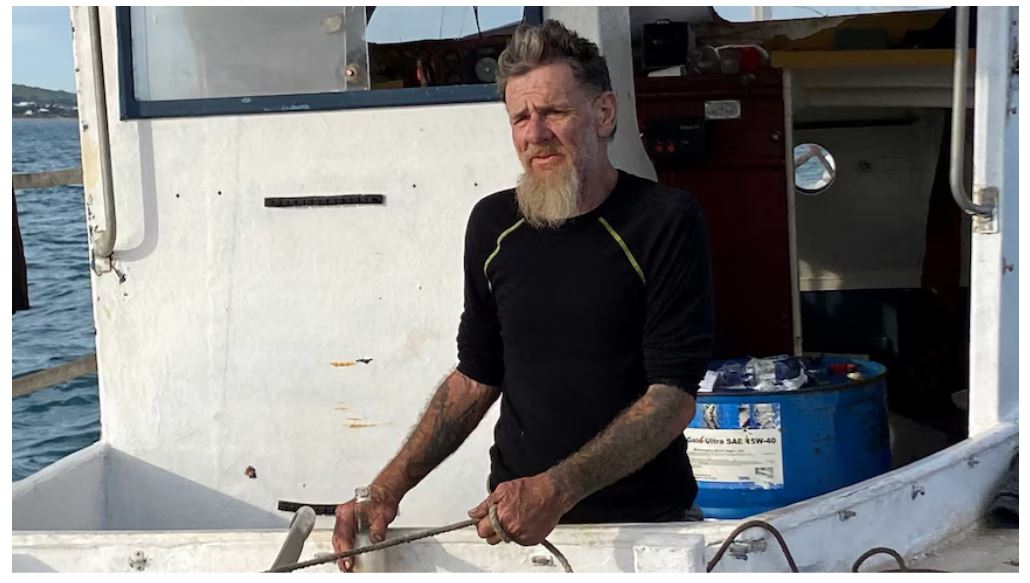
"Tony" James HIGGINS
Anthony
"Tony" James HIGGINS
Anthony
"Tony" James HIGGINS
CORONERS COURT OF SOUTH AUSTRALIA
INQUEST INTO THE
DISAPPEARANCE OF
ANTHONY JAMES HIGGINS
[2025] SACC 37
Inquest Findings of his Honour State Coroner Whittle
27 November 2025
CORONIAL INQUEST
Examination of the circumstances of the disappearance of a man who was last known to be at sea off Granite Island. The inquest explored the prior occasions of difficulties experienced with the boat, how it came to be at sea against advice and what brought about its sinking.
Held:
1. Anthony James Higgins, aged 57 years of Goolwa, disappeared from the site of the last known mooring of his boat the Margrel, near Granite Island, Victor Harbor, on 21 September 2020.
2. Mr Higgins attempted to motor the Margrel from Victor Harbor to Goolwa via the Murray Mouth but foundered in rough waters on the ocean side in the vicinity of the Murray Mouth, upon which the Margrel and Mr Higgins were lost.
3. Mr Higgins died on 22 September 2020 in the Southern Ocean near the Murray Mouth, in the State of South Australia.
4. The cause of Mr Higgins’ death was exposure to the sea.
5. Circumstances of disappearance as set out in these findings.
No recommendations made.
INQUEST INTO THE DISAPPEARANCE OF
ANTHONY JAMES HIGGINS
[2025] SACC 37
Introduction
1 Mr Anthony James Higgins was born on 5 September 1963 in Adelaide. The family lived in the Adelaide suburb of Paradise. Mr Higgins’ mother died very young, in 1966, and the children were then brought up by their father. From the age of about 12, however, he spent time in welfare homes in South Australia following which, at the age of 14 years he moved to Western Australia and lived with his cousin’s family.
2 In Western Australia Mr Higgins met Jacqueline Kelly and they had a son, Cahill Kelly, in 1990. They did not stay together, and Mr Higgins had very limited contact with his son over the years. Ms Kelly said that Mr Higgins spent some 25 to 30 years working as a deckhand on commercial fishing boats. He was sometimes required to steer boats when the skipper was sleeping but never held a boating licence.
3 In 2018 Mr Higgins returned to South Australia unannounced, turning up at the house of his younger sister, Bernadette, in Paradise. He then moved into a caravan in the yard of Dianne McHughes, who lived in Goolwa.
4 He was known to be generally physically fit but suffered from arthritic pain and depression.[1] His friends described him as an intelligent, hard worker who seemed to be able to turn ‘anything into anything’.[2]
5 Mr Higgins disappeared at sea on the morning of 22 September 2020. He was unable to be located after a six-day search and is believed to have drowned that day. His body has not been recovered.
6 As a person normally resident in South Australia who has disappeared, this Court has the power to hear an inquest pursuant to section 21(1)(b)(ii) of the Coroners Act 2003.
Background
7 Mr Higgins’ disappearance followed his purchase of a wooden boat named the Margrel in September 2020. His good friend Michelle Giles recalls that on 1 September 2020, Mr Higgins travelled to Coffin Bay to collect the boat.[3]
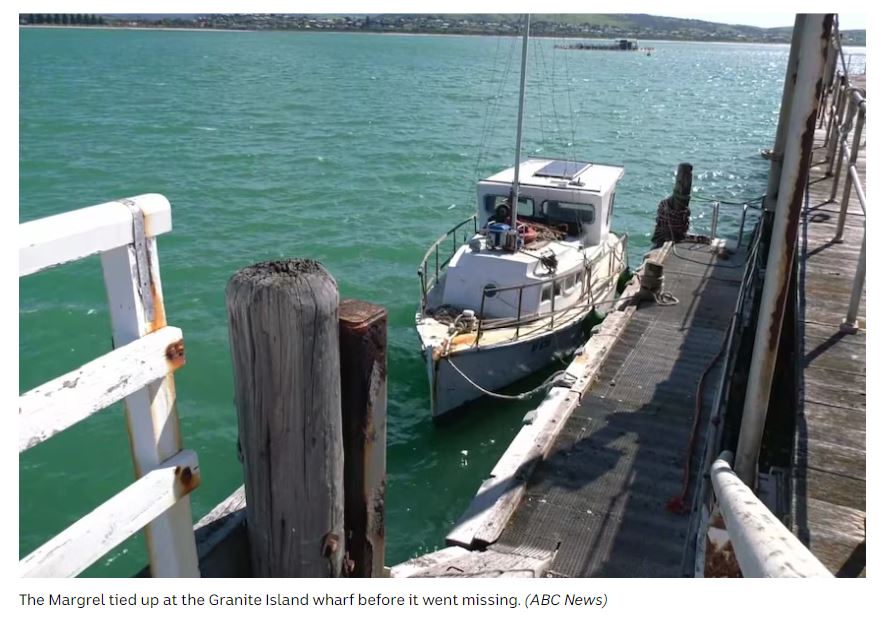
8 Mr Higgins purchased the boat from Grant McCracken who, with his wife Glenys, had owned it and maintained it since 2004.[4] The Margrel had been built in 1954 at Port Lincoln, for Mrs McCracken’s father and her uncle. It was a 33-foot jarrah hulled vessel, which had nine or ten owners during its lifetime and was used almost entirely for recreational purposes on the West Coast between Ceduna and Tumby Bay, but mostly around Coffin Bay and Port Lincoln. It was powered by a Yanmar inboard three-cylinder diesel engine driving a three-blade propeller and was known to have handled open waters well. According to Mr McCracken, when he sold the Margrel it was in fair condition, but required some ‘TLC’. As far as he knew, the motor and propeller were in good condition.
9 Derek Robinson[5] was a friend of Mr Higgins who travelled to Coffin Bay with him to collect the Margrel. On arrival in Coffin Bay, Mr Higgins slipped the Margrel for three days to clean the hull and undertake some repairs before setting out to sea. The plan was to motor from Coffin Bay into the Murray River at Goolwa. Mrs McCracken provided Mr Higgins with navigational charts of the area from Eyre Peninsula to Goolwa. The boat carried life jackets, but the emergency flares and Emergency Position-Indicating Radio Beacon (EPIRB) had passed their expiry dates. Mr Higgins had never held a boat licence. He told Mr Robertson he had been around boats for 25 years and knew what he was doing. Local fishermen later informed SAPOL that they had expressed concerns to Mr Higgins about the weather, the size of the boat and the safety equipment he had on board.
10 On 4 September 2020, the second day of the voyage, the boat hit an object which damaged the propeller, after which the boat was vibrating, and speed was reduced to only about three knots. Mr Higgins telephoned Ms Giles and told her what had happened. He also called Dianne McHughes, at whose house he had been living in Goolwa.
11 Two days later Ms McHughes called police and reported Mr Higgins and Mr Robinson missing, as she had been unable to contact them since 4 September 2020.
12 A major aerial and marine search was commenced, receiving much media attention. It covered approximately 103,000 square kilometres of ocean and coastal areas around Kangaroo Island and in Investigator Strait, Spencer Gulf and Gulf St Vincent. It was the largest and most extensive marine search operation conducted in South Australian waters, involving numerous search aircraft (helicopters, fixed wing and jets), vessels and personnel over a five-day period. Sergeant Doecke[6] of the Operations Unit, Special Tasks and Rescue (STAR) Group states that the search cost over $680,000 for search aircraft and police vessels alone.
13 At 10:30pm on 9 September 2020, Mr Higgins contacted police by mobile phone and reported that they had washed ashore at Salt Creek. According to Mr Robinson, Mr Higgins had repaired the propeller shaft at Salt Creek, which was moving around, by ‘nailing it down’. Mr Higgins told police that they were fine but needed help to be pulled out; he was apparently unaware of the search.
14 The next morning at 8am, Police Water Operations attended and towed the Margrel out to sea and to Victor Harbor, where it was tied up to the Screwpile Jetty.
15 I am informed in the statement of Sergeant Kevin Doecke[7] of the SAPOL Water Operations Unit that in media interviews Mr Higgins was openly critical of police for preventing him from completing his journey to Goolwa. Quite apart from concerns about the seaworthiness of the Margrel, and the treacherous bar crossing of the Murray Mouth which Mr Higgins was contemplating, such criticism was without foundation, as Mr Higgins was illegally operating the Margrel without a boat operator’s licence and without certain required safety equipment. The continuing commission of these offences could not be allowed by police, who were left with no alternative but to tow the boat.
16 Mr Robinson said that when the Margrel was being towed by the police boat, it was going too fast and flooding with water, which he and Mr Higgins had to bale out. During the tow, Mr Higgins rang Ms Giles and told her the bilge pump was not working too well and that the boat had started to pull apart a bit, and the police had to slow down so that they did not drown the boat.[8] Photographs of the Margrel under tow are attached to the statement of Sergeant Doecke.[9]
17 Upon arrival at Victor Harbor, police photographed the boat and inspected it and its contents. Mr Higgins was issued expiation notices for having expired flares and an expired EPIRB, as well as for operating the boat without a licence. Mr Higgins was directed not to operate the boat without an appropriate licence.
18 The Margrel was described as being in a very poor and dilapidated condition, with deteriorated and broken floorboards, and wallowing in water at floorboard level through the cabin and bilge areas.
19 Mr Higgins elected to stay on board the boat to keep an eye on water ingress and bilge pump operations so the vessel did not sink.
20 I note that the Margrel did not remain tied up at the Screwpile Jetty and instead was moored away from the jetty nearer the Granite Island Causeway. Mr Higgins did not have a tender attached and so if he needed to come ashore, he needed to move the Margrel and tie up to the Causeway. Mr Higgins later complained to Mr Robinson about the place he had been left docked, which was causing damage to the boat as the waves pushed it against the jetty.
21 A television crew interviewed Mr Higgins upon his arrival in Victor Harbor. In the interview Mr Higgins was dismissive of the suggestion that he was at risk and said he did not know what all the fuss had been about. In a newspaper report he was quoted as saying:
‘People have been punching around the ocean for thousands of years. They never had anyone to go out and rescue them, and I never expected anyone to look for me. I’m self-sustaining and if I fuck it up, then I have to pay the price.’[10]
22 The morning after the Margrel’s arrival at Victor Harbor, Ms Giles delivered a bilge pump and cigarettes to Mr Higgins. On Friday 11 September 2020 she took water, food and supplies to the Causeway for local tour operators to take to Mr Higgins, but they were not operating that day. Ms Giles paid some locals to take supplies to Mr Higgins, as well as a new EPIRB, flares and a fire extinguisher. On 12 September 2020 Ms Giles bought Mr Higgins a float switch, after which she understood the Margrel to have two operational bilge pumps. On Tuesday 15 September 2020 she helped Mr Higgins collect generators, fuel, more food and cigarettes. On Friday 18 September 2020, Mr Higgins told Ms Giles he was sick of sitting out in the bay and just wanted to get the boat home to the river at Goolwa.
23 On the weekend of 19 and 20 September 2020, Mr Higgins told Ms Giles that the mast had come down in the weather. Ms Giles suggested they ‘go back to plan A’ and get a trailer from people she knew, to collect the vessel and transport it to Goolwa, where repairs could be done and the boat moored. Mr Higgins told her not to organise anything yet, as the weather was rough and he would have to wait it out, saying he wanted to fix the propeller.
24 On 19 September 2020 Mr Higgins ran the Margrel aground again as he tried to move it to a different point in Encounter Bay, trying to get closer to shore. While the boat now had flares and EPIRB within expiration date, Mr Higgins still did not have a boat licence and there is no evidence he had taken steps towards obtaining one.
25 On the morning of Monday 21 September 2020 Mr Higgins told Ms Giles over the phone that the seas were worse in the Bay than he had experienced coming across from Coffin Bay. He said he had lost some of his railing and his front window was broken and water was splashing in. During this conversation he said that the mooring rope was okay but said he might start the motor to try to help hold the boat where it was.
26 According to information provided to police during the later search,[11] local experienced fisherman Rod Ness noted, at about 4:30pm on Monday 21 September 2020, that the Margrel was listing to the left as if it had taken on water. He had been keeping an eye on the boat and had previously warned Mr Higgins that it would sink or get washed up on the rocks as the mooring or rope and anchor he had been using would not hold a vessel of that size in the forecast storm and pending weather conditions. Mr Higgins was offered the use of a stronger mooring but had refused.
27 I find that by Monday, 21 September 2020 Mr Higgins had provisioned the Margrel with fuel and other supplies sufficient to undertake a trip from Victor Harbor to the Murray Mouth and into Goolwa. The nature of these preparations do not suggest that he intended to take the boat to Goolwa by trailer. Indeed, on that day, he rejected Ms Giles’ offer to arrange a trailer for that purpose.
Police and other regulatory responses
28 Sergeant Doecke’s statement[12] details the manner in which police and DIT authorities intended to deal with Mr Higgins’ apparent disregard of the order not to operate his boat without a licence, and ongoing concerns about the safety of the Margrel.
29 On Monday, 21 September 2020 there was a discussion between SAPOL Water Operations Unit member Brevet Sergeant Leske and Department of Infrastructure and Transport (DIT) Marine Safety Officers (MSO) in relation to Mr Higgins’ disobedience of the earlier police direction not to operate the vessel unless holding an appropriate licence by again operating the vessel on the weekend of 19 and 20 September 2020 when, according to media reports, he ran aground near the Granite Island Causeway.
30 The DIT MSOs advised Brevet Sergeant Leske they were aware of the incidents and intended to report Mr Higgins for further offences of operating a vessel alone without a personal flotation device and operating a boat without a boat operator’s licence.[13]
31 The DIT officers were also in discussion and liaison with local police and were intending to issue Mr Higgins with a direction to move the Margrel from its current location, remove it from the water and not return it until a seaworthiness certificate could be produced from a surveyor. These are powers[14] which rest not with police but with the Chief Executive (CE) of DIT, if the CE suspects on reasonable grounds that the vessel is unsafe.
32 Expiation notices for offences committed by Mr Higgins during the weekend could have been issued on the Monday immediately following the weekend, but the authorities cannot be criticised for not doing so immediately, on the first business day after the weekend. There is no evidence that they should have been aware that Mr Higgins was planning to leave illegally, under the cover of darkness, that very night, even though it is now known, after an investigation, that the signs were there.
33 Although with the benefit of hindsight it might be thought that a prohibition order could or should have been issued earlier, there is no basis upon which to conclude that the CE of DIT should have issued such order before Mr Higgins’ disappearance. It is evident that steps were being taken to do so, and it is also evident that Mr Higgins was being secretive about his intentions.[15] In addition, it is plain that DIT MSOs would have been well aware that Mr Higgins had been directed by police not to operate his boat without an appropriate licence.
34 Whether the Margrel was towed too fast during the journey from Salt Creek to Victor Harbor and, if so, whether this caused damage or otherwise contributed to its poor condition by the time it arrived at Victor Harbor, is a matter which was not investigated in this inquest and about which I cannot draw any conclusions. In any event, Mr Higgins did not have a boat licence, it was illegal for him to operate the boat without a licence, and he had been directed by police not to do so without an appropriate licence. Police and DIT MSOs were entitled to rely on Mr Higgins obeying the law and obeying the direction. In addition, Mr Higgins was well aware of the poor condition of the boat, whatever may have been the cause or causes of its condition. It had undoubtedly been in dubious condition, at the very least, prior to its trip from Coffin Bay and certainly by the time police took it under tow after its voyage to Salt Creek. By the time it got back to Victor Harbor there was no doubt about its tendency to take on water, and by the time Mr Higgins left Victor Harbor, it apparently also had a broken window.
Mr Higgins’ disappearance and telephone contact with police
35 Mr Higgins was last seen on 21 September 2020 by taxi driver Jeffrey McEvoy,[16] who at about 9:10pm picked up Mr Higgins, whom he recognised from media coverage. Mr Higgins was carrying a backpack full of supplies. Mr McEvoy took Mr Higgins from Woolworths and dropped him at the Causeway after stopping at the Crown Hotel to collect a bag of ice he had purchased earlier. CCTV footage showed Mr Higgins sheltering at a café before walking out along the Causeway towards where the Margrel is believed to have been moored.[17] Mr Higgins told Mr McEvoy he was trying to arrange a trailer to take the boat to Goolwa.
36 There is no direct evidence of what happened from the time Mr Higgins got back to the boat, until 5am the following morning.
37 At about 5am on 22 September 2020 Mr Higgins contacted police. I have listened carefully to a recording of the call.[18] Mr Higgins was in a panicked state and said he did not know where he was but was in a room filled with water. The call taker spoke with him for nearly 10 minutes, ascertaining his identity and that he believed he was on his boat, which he said was moored at Victor Harbor, near Granite Island.
38 During the call Mr Higgins sounded confused and struggled to speak clearly. He confirmed that he was wet and freezing cold. He said the last thing he remembered was being on the boat, and something about being tied up and heading towards rocks. He said at one point he thought he was losing the plot. The call taker was persistent in seeking more details, in an effort to identify who and where he was.
39 It is noted that Mr Higgins gave an impression of possibly being intoxicated, but all that can be determined is that Mr Higgins was showing signs of significant confusion and was struggling to speak clearly and make himself understood. Although it is known that Mr Higgins had purchased ice from the Crown Hotel the previous night, it is not known whether he had any alcohol on board. Even if he did, according to Ms Giles, he did not drink to get drunk and was ‘a social drinker’. During the call Mr Higgins was, by his own assertion, soaking wet and freezing. He was plainly confused. The windows of the Margrel were known to be broken, it was approximately 5am and winds were high. According to Sergeant Minchin,[19] the overnight minimum temperature on 21 September 2020 was 11°C and 10°C overnight on 22 September 2020.
40 In my opinion, all the circumstances suggest it is likely that at time of the call, wherever he was exactly, Mr Higgins was suffering from the effects of hypothermia, rather than intoxication.
41 Constable Steven Muir was tasked to assist following Mr Higgins’ call, and he contacted Mr Higgins via his mobile phone. He commented that Mr Higgins did not appear to be making sense and sounded intoxicated, which is again consistent with suffering hypothermia.[20] During the call Mr Higgins said he had water up to his knees and Constable Muir advised him to put a life jacket on and ended the call because of Mr Higgins’ concerns about his phone battery.
42 Police then drove to the foreshore at Victor Harbor to see if they could locate the vessel. They saw a vessel with its lights on, thought to be approximately the same length as the Margrel, which appeared to be sitting low in the water. The water, however, was quite calm in that location. At 5:34am police again spoke with Mr Higgins on the phone and he said to them that he could see their flashing police lights. Constable Muir informed Mr Higgins that Sea Rescue was approximately 20 minutes away but Mr Higgins responded that the Margrel would not last that long.
43 As the sun rose it became apparent to police that the vessel they could see was not the Margrel and was a tuna pen boat. Police called Mr Higgins again and, when asked, he said that he could still see their flashing blue lights. However, police emergency lights were not on at the time, which confirmed that Mr Higgins was not providing reliable information. In this last call, Mr Higgins sounded panicked and stated that his boat was going down and that he needed help. The line cut out and no further attempts at contact were successful. Constable Muir walked around Granite Island but could not see the Margrel from any point. I am satisfied that at the time he was talking to Constable Muir, the Margrel and Mr Higgins were not in the close vicinity of Granite Island.
The search for Mr Higgins
44 A second extensive search was commenced, coordinated by Sergeant Minchin,[21] of Victor Harbor police and Sergeant Doecke. This search involved the use of police ground units, aircraft and watercraft.
45 Based on weather conditions and Mr Higgins’ age, it was estimated that if he entered the water, even wearing a life jacket, he would not survive beyond two hours.
46 Sergeant Doecke[22] provided a detailed explanation of the search that was conducted, including maps showing the flight paths of aircraft.
47 A mobile phone triangulation undertaken at 6:09am, suggested the call could have been made in an area up to 5 km south-southeast of Granite Island. However, triangulation could be used as a guide only because it is unreliable from mobile phones transmitting at sea, due to transmission anomalies over water.
48 Although the triangulation was not at any time able to pinpoint the location of the phone, Mr Higgins phone was being actively detected from a single tower located at Greenhill Road, Victor Harbor until 9:53am on 22 September 2020.[23]
49 Wind was already averaging about 20 knots from the west-northwest, with gusts to 30 knots recorded in the area. Search planning took into account drift modelling, but police did not know whether the Margrel was drifting or motoring.
50 It was ascertained there had been no EPIRB activations in the area.
51 Three Sea Rescue Squadron vessels were involved in the search and police patrols attended numerous locations along the coast, from Newland Head to Goolwa, attempting to find the Margrel.
52 Between 7:27am and 8:56am a rescue helicopter searched around Granite Island and along the coast to the Murray Mouth, then an open water area to the southeast of Granite Island, having regard to the phone triangulation, before returning to Adelaide to refuel and change crew.
53 By 9:30am, available information led search coordinators to believe that Mr Higgins was likely motoring towards Goolwa through the Murray Mouth and a police fixed wing aircraft searched what was considered to be a likely area of passage, until midday. The helicopter returned to the search at about 10:10am. At about midday both aircraft returned to Adelaide when they were unable to continue searching due to deteriorating severe weather with squalls and winds gusting to 35 knots from the west northwest.
54 At about 2:15pm, a Challenger Jet (Rescue 550) from the ARC (Australian Maritime Safety Authority (AMSA) Response Centre) was deployed from Essendon Airport to continue search efforts during daylight hours with helicopter Rescue 51 on standby in Goolwa in the event the Margrel was found. Rescue 550 searched until 5:20pm before refuelling in Adelaide.
55 At about 4pm a yellow object, and then an orange board and white board, were sighted from the aircraft, and a search vessel was dispatched to the area. These items were collected about 3.3 nautical miles west southwest from the Murray Mouth and confirmed as having come from the Margrel. An open water search was then commenced in the vicinity of the floating debris.
56 From about 7:20pm until 10:55pm the Challenger jet continued nighttime searching for a person in the water over a concentrated area calculated by reference to the debris previously located. The aircraft returned to Essendon at about 11pm. It had already been calculated that Mr Higgins could not have survived in the water beyond about nightfall.
57 Early the next day further items of debris identifiably from the Margrel were located between two and five nautical miles southeast of the Murray Mouth. These initially included loose items carried on board the Margrel such as Mr Higgins’ backpack, petrol cans and foodstuffs. Some of Mr Higgins’ personal items were recovered, including a driver’s licence, other personal documents and a mobile phone.
58 Further air searching was undertaken that day and early on the following day until this could not continue due to poor weather. Over the next several days more items and debris were located along the beach to the east of the Murray Mouth and eventually large sections of the Margrel itself were discovered. The inescapable conclusion was that the Margrel had broken up and that Mr Higgins was lost at sea. It was not known whether or not he was wearing a life jacket.
59 At the end of the third day, the search was formally suspended, other than local patrols periodically searching the beach areas for debris or for Mr Higgins’ body.
60 The search for Mr Higgins was officially abandoned on 27 September 2020 with Mr Higgins rightly presumed to have drowned.
61 I find that the search for the Margrel and Mr Higgins was well coordinated and executed and deployed all resources reasonably available to SAPOL. Despite that, Mr Higgins’ body was never found.
SAPOL investigation
62 Detective Brevet Sergeant Daniel Soper of SA Police prepared a detailed and comprehensive investigation report[24] on behalf of the State Coroner, providing statements of numerous civilians who knew and had involvement with Mr Higgins, as well as police who were involved in land, sea and air-based searching and retrieval. Also provided were records of Mr Higgins’ expenditures at Victor Harbor, and the many items which were retrieved on both sides of the Murray Mouth by police and members of the public during the search.
63 Sergeant Doecke of the Water Operations Unit, who has extensive experience and qualifications in marine and on-water policing and search and rescue management, provided a thorough account of the latter search and expressed two theories about the fate of Mr Higgins and the Margrel. First, Sergeant Doecke considered whether the Margrel may have come loose from its mooring and drifted towards the Murray Mouth. He acknowledged that this theory does not account for the initial position of the Margrel and the known direction of the wind, in that, given the location of the Margrel’s initial mooring, the winds at the time would likely have pushed it up against the jetty or the breakwater, not out to sea.
64 The direct distance from the mooring area on the eastern side of Granite Island to the Murray Mouth entrance is just over 22 km or about 12 nautical miles due east. By reference to tables published in the National Search and Rescue Manual,[25] Sergeant Doecke calculated that it would be possible for a vessel of the Margrel’s size, build and draft to drift at a rate of between 0.6 and 0.8 knots, which could take it some 5.6 nautical miles or about 10 km in seven hours from 10pm to 5am. This is only about half of the total distance from Granite Island to the Murray Mouth.
65 Of course, it is clear that the Margrel was in poor condition in any event, and it is not known at what stage between Granite Island and the Murray Mouth it became swamped to the point that it was no longer capable of proceeding under power, even if Mr Higgins was earlier running the motor.
66 Sergeant Doecke’s favoured opinion was that after refuelling and restocking supplies, Mr Higgins attempted to motor to the Murray Mouth under the cover of darkness, intending to pass through it into the calm waters of the Coorong, the River Murray and Goolwa, and that the Margrel was swamped, then capsized and sank in the heavy surf zone nearer to the Murray Mouth.
67 At a possible maximum speed of 3 knots under power, travelling with strong winds and following seas, Sergeant Doecke considered that Mr Higgins could have travelled from Granite Island to the vicinity of the Murray mouth in four to five hours, where he then came to grief. He postulated that Mr Higgins may have motored the entire distance or motored some of the way and drifted the rest while waiting for daylight.
68 As Ms Giles pointed out in her statement, it is likely that Mr Higgins would only have rung police as a last resort and it seems clear from Mr Higgins’ apparent condition and what he said during the first call at 5am, and Constable Muir’s account of the subsequent calls, that Mr Higgins was by then in very grave trouble, with a lot of water in the boat and Mr Higgins having no control over it.
69 Sergeant Doecke explained that it is not possible to plot a precise location of where the Margrel sank. Wreckage was located along many kilometres of shoreline on both sides of the Murray Mouth. Sergeant Doecke described the variability of the currents along the coastline and the difficulty in predicting where the Margrel came to grief and where Mr Higgins’ body may be:[26]
‘It is not possible to plot a precise location where the Margrel has sunk. SARMAP computer drift modelling does not take into account localised close to shore currents like those that occur along the Goolwa and Coorong coastlines. These ‘longshore’ currents are influenced by the direction of the wind, but predominantly by the angle of the large swell waves striking the coastline. When these waves have a south to SW aspect it creates a long shore current pushing items along this coastline towards the N-W. When the wind and waves have a W to N aspect this current can be reversed pushing items to the E-S.
Generally in this area the primary swell waves have more of a southerly aspect, creating an undercurrent close to shore along this coastline and pushing submerged or semi submerged items drifting within the surf zone in a north-westerly direction. The wreck of the Margrel is most probably relatively close to shore, within the surf or outer surf zone, which has caused the wreck to break up in the large breaking waves created by the severe onshore weather conditions. The remainder of wreckage could be in the vicinity offshore from where the larger heavier items have been located. It could also be in the vicinity but further west from where the light buoyant items were first blown ashore by strong westerly winds and located by commercial cocklers on the morning of Wednesday, 23 September 2020 (between 2 to 6 km southeast from the Murray Mouth).
This is not conclusive and is just a theory. When conducting back drift calculations even in open water, SARMAP does not provide a precise location, but shows a large area of probability where the vessel may be located. The wreck could also possibly be further offshore, creating an area too large to successfully sonar search, and especially within the surf zone, too dangerous for vessel sonar or underwater dive searching to occur.
It is possible Higgins may have been wearing one of the lifejackets which washed ashore in this area, when he entered the water, or was trapped inside the cabin area if ‘Margrel’ capsized in the surf zone. If the lifejacket wasn’t secured correctly or had perished waist straps …, then he could easily have slipped out of the lifejacket if he was tumbled in the heavy surf zone.
As Higgins was of thin build, without the assistance of a lifejacket, it is likely he would have been negatively buoyant, especially fully clothed in the foaming surf zone where his body has likely sunk and been easily moved by the undercurrent and force of breaking swell waves.
I believe his remains are somewhere along this surf zone area. Either between the breaking swell waves and shoreline or more likely they have been taken further out to sea in a rip and have settled in a calmer area outside of the surf zone or been trapped within the remaining outstanding heavier sections of Margrel’s wreckage.
If Higgins had floated, I believe his remains would have washed ashore and been located.’
70 There are compelling reasons for me to agree with Sergeant Doecke’s favoured theory that Mr Higgins decided to attempt to motor to the Murray Mouth and through to Goolwa, as he had originally intended, notwithstanding the comment he made to Mr McEvoy about trying to arrange a trailer:
a) Mr Higgins was known to have taken steps to make the Margrel more seaworthy than it was when he arrived at Victor Harbor, refuelled and obtained water and food;
b) Very shortly before the Margrel’s departure, Mr Higgins rejected Ms Giles’ suggestion to ‘go back to plan A’ and allow her to arrange through friends the use of a trailer for the purpose of taking the Margrel to Goolwa;
c) The location of floating debris and of debris washed ashore was in keeping with the Margrel breaking up in the water near the Murray Mouth, which was further away from Granite Island than the Margrel would have been expected to drift in the available time, suggesting that the Margrel had motored in that direction;
d) Mr Higgins had demonstrated poor safety-consciousness and decision-making in his voyage from Coffin Bay and had expressed his continued desire to motor the Margrel to Goolwa.
71 Proof of life checks conducted by SAPOL demonstrate no activity on Mr Higgins’ bank accounts following payment for the taxi on 21 September 2020.[27]
Conclusions
72 I find that on the evening of 21 September 2020, Mr Higgins attempted to motor the Margrel from Victor Harbor to Goolwa via the Murray Mouth but foundered in rough waters on the ocean side in the vicinity of the Murray Mouth, upon which the Margrel and Mr Higgins were lost.
73 I find that Mr Higgins died on 22 September 2020 in the Southern Ocean near the Murray Mouth, in the State of South Australia.
74 I find the cause of Mr Higgins’ death to be exposure to the sea.
75 Mr Higgins’ death was the result of his choice to set off in a boat which was unsafe and in need of repair, illegally, without a licence, under the cover of darkness, intending to navigate the Murray Mouth to Goolwa. He must have known that if he did so in daylight he would probably be observed, leading to steps being taken to stop him.
76 I find that the efforts to locate Mr Higgins were comprehensive.
77 I make no recommendations.
An inquest into the death of a man who went missing in waters south of Adelaide in 2020 — two weeks after he and a friend had been found during the state's biggest maritime search — has concluded, with the coroner making no recommendations.
State Coroner David Whittle has handed down his findings into the death of Goolwa man Anthony 'Tony' James Higgins, who was last seen at the site where his boat was moored at Victor Harbor on September 21, 2020.
It was the second time in the same month that he had been lost at sea.
Mr Whittle found that the 57-year-old died on September 22, 2020, in the Southern Ocean near the Murray Mouth, with his cause of death "exposure to the sea".
"Mr Higgins' death was the result of his choice to set off in a boat which was unsafe and in need of repair, illegally, without a licence, under the cover of darkness, intending to navigate the Murray Mouth to Goolwa," he wrote.
"He must have known that if he did so in daylight he would probably be observed, leading to steps being taken to stop him."
The inquest explored the prior difficulties experienced with the boat, named the Margrel, how it came to be at sea against advice, and what brought about its sinking.
According to the coroner's findings, Mr Higgins attempted to motor the 10-metre wooden boat from Victor Harbor to Goolwa via the Murray Mouth but "foundered in rough waters on the ocean side in the vicinity of the Murray Mouth, upon which the Margrel and Mr Higgins were lost".
The search for Mr Higgins followed a separate successful search two weeks prior, when Mr Higgins — who had recently bought the Margrel — and a friend set out to travel from Coffin Bay, on the Eyre Peninsula, to Goolwa, but were reported missing to police a few days later.
A major search began on September 6 — the largest and most extensive marine search operation conducted in South Australian waters — until the pair contacted authorities on September 9 and the boat was towed by police to Victor Harbor.
Mr Higgins told the ABC at the time that he was unaware of the search, and thanked those involved.
At the time, the boat was described as "being in a very poor and dilapidated condition, with deteriorated and broken floorboards, and wallowing in water at floorboard level through the cabin and bilge areas," the coroner wrote in his findings.
The coroner wrote that Mr Higgins "did not have a boat licence, it was illegal for him to operate the boat without a licence, and he had been directed by police not to do so without an appropriate licence".
Mr Higgins decided to stay on the boat, anchored off Granite Island, to ensure it did not sink.
Two weeks later, Mr Higgins again went missing at sea, contacting police at about 5am on September 22, 2020.
The coroner described Mr Higgins as being being in a "panicked state" and said that he "sounded confused and struggled to speak clearly" during the call.
Mr Higgins said he did not know where he was, but was in "a room filled with water", and was "wet and freezing cold".
The coroner said "all the circumstances suggest it is likely" in his opinion that Mr Higgins was suffering from hypothermia at the time of the call.
Mr Higgins told a police officer who subsequently called his mobile that he had water up to his knees, and was advised to put on a life jacket.
A second extensive search began and while parts from the boat as well as other items including Mr Higgins's identification were discovered, his body was never found.
"The inescapable conclusion was that the Margrel had broken up and that Mr Higgins was lost at sea," the coroner wrote in his findings.
"It was not known whether or not he was wearing a life jacket."
The search was suspended at the end of the third day, aside from periodic searches of beach areas, and officially abandoned on September 27, with Mr Higgins presumed to have drowned.
The coroner wrote that the search was "well coordinated and executed and deployed all resources reasonably available to SAPOL".
He concluded that the efforts to find Mr Higgins were "comprehensive", and he made no recommendations.